The Passage Through a Room: Why Clear Routes Change Its Feel
Clear routes through a room make everyday movement feel easier. Learn to observe doorways, furniture, and habitual paths before changing the layout.
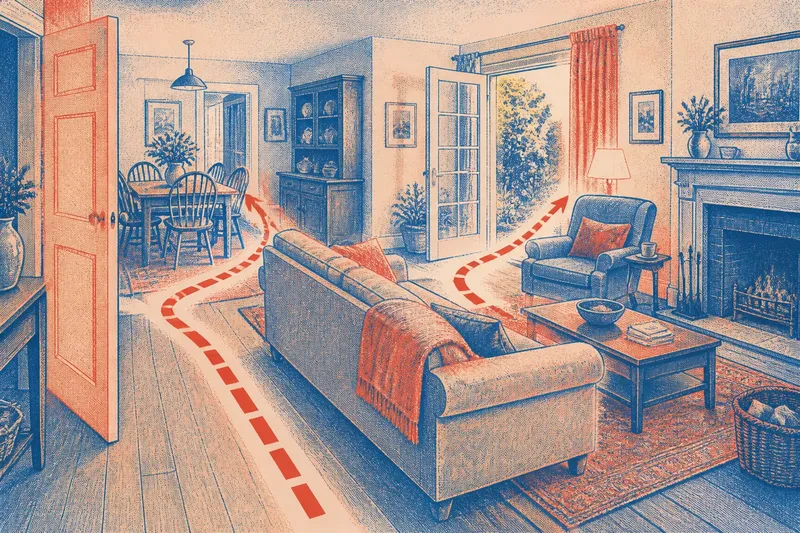
A room feels easier to enter when the route from its doorway to its most-used seat is legible and unobstructed. Clear routes through a room are not a matter of following a fixed furniture plan; they begin with noticing where people already walk, pause, and turn. Before shifting a chair or table, watch the room at the times it is actually used.
Where does the room’s natural route begin?
Start at each doorway, including openings that lead to another room or to a garden. Stand just outside and look in. Notice what draws you forward: a window, a fireplace, a table set for meals, or the chair where someone reads. Then look at the line your body takes to reach it. A route may bend around a sofa or skirt a hearth instead of crossing the center.
Repeat the observation from the room’s other entrances. A sitting room with a door to the hall and a glazed door to the yard has more than one arrival point. The most direct route from one opening may pass through the area where someone rests, while another route can follow the room’s edge. Those paths matter even if one is used only at certain times of day.
Watch without asking anyone to change their habits. A family member may carry a cup to a window seat, pass behind the dining chairs, or leave a basket beside the door. The small detours are useful clues. They show where the room’s present arrangement asks people to slow down, squeeze past, or step around something.
What should you observe before moving anything?
For a few ordinary periods of use, notice the room during its usual occupations rather than staging a walk-through. You might watch morning tea, a visit from a neighbor, or the quiet hour when someone reads. Keep track of recurring movements, not every incidental crossing. A route used repeatedly deserves more attention than an unusual trip to fetch a book.
Look at the furniture from the viewpoint of someone carrying something. A tray, laundry basket, kindling bucket, or child’s toy changes how much room a passage seems to need. Notice where a person turns to avoid a corner and whether that turn puts them close to a lamp, low table, or open drawer. Do not infer a problem from one awkward moment; wait to see whether the same hesitation recurs.
You can use removable painter’s tape to mark the edges of a proposed change, but only after you have observed the existing route. A strip on the floor can make an imagined shift easier to judge without committing to moving heavy furniture. Keep tape away from delicate finishes, and follow the surface maker’s care guidance if you are unsure what will lift cleanly.
How do you tell a route from empty floor?
Open floor is not automatically useful floor. A broad bare patch between a sofa and a window may contribute little if nobody crosses it, while a narrower passage beside the sofa may serve the room all day. Judge a route by its origin, destination, and frequency: does it join two places people actually use, and does it work during the room’s ordinary activities?
Some paths are purposeful but temporary. A dining chair needs room to move back when someone sits down; a cupboard door needs a clear swing; a person tending the fire may need to reach the hearth without interrupting a conversation. These movements are part of the room’s circulation too. Consider them before treating a chair or cabinet as an obstacle simply because it occupies the center of a view.
Separate a route from a view. A clear sightline from the doorway can make a room seem composed, but people may not need to walk along that line. Conversely, a route around the side of a table may be comfortable even when it is not visually prominent. The goal is not to expose the whole room at once. It is to make the next ordinary movement feel unforced.
Which furniture is shaping the passage?
Look first at pieces that project into a route: the corner of a sofa, a dining chair left slightly out, a small table with a low shelf, or a basket that has become a permanent landing place. Observe what happens when the piece is in use, not only when it is neatly pushed back. A passage that works only in a carefully reset room may not suit the household’s daily rhythm.
Next, consider how furniture faces. A chair turned toward the hearth may invite conversation but leave its back close to a doorway. A narrow console can guide movement along a wall, while a deep cabinet may make the same approach feel pinched. No piece has to be removed merely because it affects the route; sometimes a slight change in orientation or a different place for a frequently carried object addresses the snag.
Rugs and floor lamps also influence where people step. A rug edge can mark a natural transition between sitting and walking areas, but a curled corner or loose fringe may catch a foot. A lamp can make a reading place welcoming, yet its cord should not cross a commonly used passage. For electrical or other safety-sensitive changes, use the manufacturer’s directions and consult a qualified professional where needed.
How can you try a change without committing?
Choose one recurring obstruction, then alter only the furniture or object connected to it. Move a small table out of the route, turn a chair slightly, or relocate a basket to a place that still serves its purpose. Leave the rest of the room as it is. A single change makes it easier to notice whether movement improves or whether the apparent obstacle was not the real cause of hesitation.
Say you notice that people carrying mugs from the kitchen turn sharply around the end of a sofa before reaching a window seat. Imagine shifting a lightweight side table away from that corner and placing it beside the chair instead. Over the next few ordinary visits, the observable result to look for is whether the turn becomes less abrupt without making the seat harder to use or placing the table in another route.
Keep a change if it helps the room’s actual routines; reverse it if it merely makes the floor look neater. It is not worth the effort to keep moving every piece in search of a theoretically perfect plan. The useful adjustment is the one that addresses a repeated difficulty and still lets the room support its other purposes.
What questions help you judge a clear route?
How wide should a path through a room be?
There is no single width that suits every room or household. Notice whether people can pass naturally while the room is in use, and consider the furniture, mobility needs, and objects they carry.
Should a walking route go through the middle of the room?
Only if that is where the room’s use naturally leads. A route along a wall may keep conversation or rest undisturbed, while a central route can make sense between a doorway and a frequently used table.
How can I tell if a furniture change has helped?
Look for fewer repeated sidesteps, abrupt turns, or requests to move an object during ordinary use. Also check that the change has not made another doorway, seat, cupboard, or activity harder to reach.
What if several people use the room differently?
Observe the routines that overlap and the times when they conflict. A layout can preserve more than one useful route, but it may also need a compromise that keeps the most frequent movements clear without treating occasional needs as irrelevant.
When should you stop adjusting the room?
Stop when the main routes feel natural during the activities the room needs to hold, even if the arrangement is not symmetrical or the floor is not entirely open. A living room can accommodate a path to the garden, a clear approach to the hearth, and a quiet place to sit without making every object line up around a single axis.
Then check the room at a different moment. A chair pulled back for supper or a basket set down after a walk may reveal a conflict that was invisible during a quiet hour. If a recurring route still feels awkward, revisit the observation rather than making several new changes at once. Clear routes through a room grow from attention to lived habits: the doorway people choose, the turn they make, and the place they return to when they are done.
Leave room for habits to change, too. When a new activity becomes part of the day, notice its path before deciding that the furniture must stay as it is. The best arrangement is not a finished diagram; it is a room whose passages continue to make sense to the people who use it.